You and AI,
unified
You and AI,
unified
YounndAI is the philosophy and architecture of human first intelligence.
Before any tool is built, the law and the story step forward.
Where YounndAI begins. Before the tools, there is a law and a story.
The law explains how intelligence should behave. The story explains why YounndAI exists at all. Together they keep humans at the center while systems scale.
The Guide
Philosophy of human first intelligence
The Guide names the quiet law beneath YounndAI. Four principles and one architecture that say intelligence should be structured, human-first, and continuous, not improvised or extractive.
Read the GuideThe Story
How "You and AI, unified" took shape
The Story traces how YounndAI moved from a phrase into an architecture. It shows why intelligence is treated as shared space between people and systems, not a replacement.
Read the StoryLaw and story form the quiet ground beneath YounndAI.
From philosophy, we condense into principles that can hold real work.
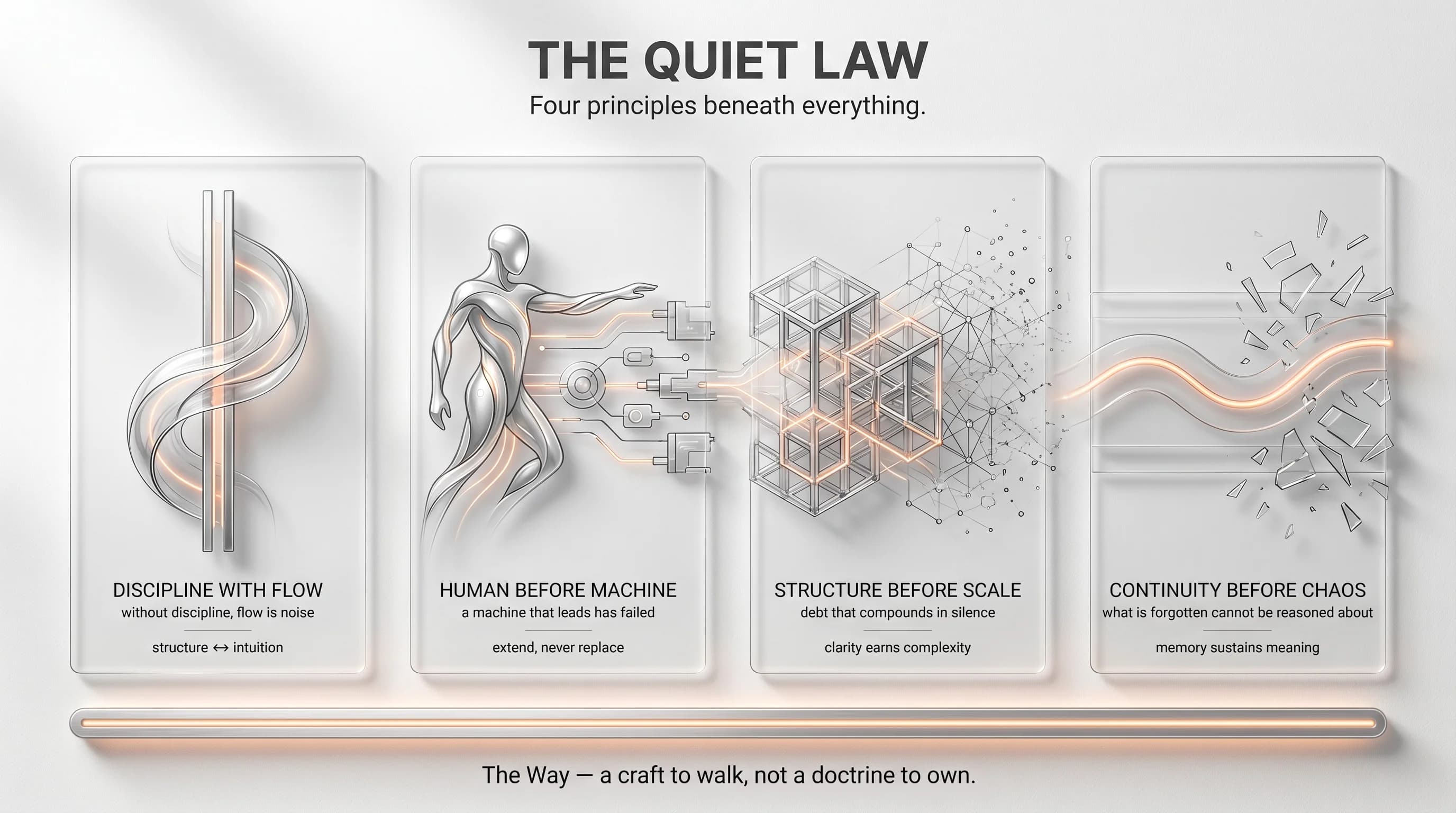
The Guide condenses the philosophy of human first intelligence into four principles that form the quiet law beneath every Element and System.
Discipline with Flow
Structure and intuition move together. Systems have clear shapes, but leave room for human judgment and change.
Human before Machine
People keep final control. Keys, data, and decisions stay owned by the organizations that use the tools, not by the tools themselves.
Structure before Scale
Complexity is earned. Each Element has named entities, lifecycles, and scopes so growth adds volume, not confusion.
Continuity before Chaos
Memory sustains meaning. Logs, provenance, and governed recall keep intent from eroding over time.
These principles form the quiet law beneath every Element and System.
Once the law is named, the tools take form.
YounndAI does not ship as one monolith. It appears as Elements and Systems that each have a clear job:
- •Byte shapes thinking and context before models.
- •Frame holds identity and truth before words.
- •Tale keeps campaigns in rhythm.
- •Mark keeps visuals on brand.
- •Lyt turns activity into governed memory.
You can use any one on its own. You can use several together. They simply share the same law and the same account.
Byte (BYT)
The Architect of Thought
Context and prompt orchestration platform for LLM workflows.
Byte is the thinking layer you place in front of your models. It breaks long prompts into modular Bytes for instruction, context, grounding, examples, expression, format, and policy, then assembles them into Prompt Graphs that can be resolved and run with provenance.
Where it helps
- • Prompts live in chats and docs
- • Context changes faster than prompts
- • Live data not in visible pipeline
Who it's for
- • Product and AI teams
- • Agencies and multi-client setups
- • Ops and automation builders
Frame (FYS)
The Guardian of Identity
AI brand voice and context hub.
Frame is your brand voice and context hub, the place where tone, rules, and structured facts live as Frames and Libraries instead of scattered docs. It resolves them into Frame Snapshots, versioned identity and context packs that any app, agent, or workflow can fetch as pre context.
Where it helps
- • Voice trapped in slides and sheets
- • Agents call models without pre context
- • Multi-client work risks leaks
Who it's for
- • Product, brand, and UX teams
- • Agencies managing many clients
- • Governed organizations
Tale (SYT)
The Weaver of Stories
Narrative orchestration platform for multi-channel campaigns.
Tale turns campaigns into Stories with Threads per channel and Content that inherits shared context. It keeps approvals in one place, then hands approved pieces to a webhook first scheduler that delivers into your existing tools with provenance and delivery logs.
Where it helps
- • Each channel tweaks copy off-beat
- • Approvals drift across chats
- • Calendars live in separate tools
Who it's for
- • Marketing and content teams
- • Agencies running campaigns
- • Enterprises needing approvals
Mark (DYM)
The Artist of Presence
Visual and media orchestration system for on-brand AI images.
Mark is your palette first visual layer. You define Palettes with colors, logos, watermark rules, channel presets, and safety constraints. Mark assembles a Visual Prompt Package, calls the image capability, runs transforms, and delivers assets with provenance and webhook first handoff to your stack.
Where it helps
- • AI images ignore brand rules
- • Prompts cannot be reproduced
- • Teams resize and watermark by hand
Who it's for
- • Product and AI teams
- • Creators and content teams
- • Agencies and governed orgs
Lyt (LYT)
The Archivist of Memory
API first cognitive AI memory layer for agents, LLM apps, and RAG.
Lyt is your AI memory layer. It ingests information from documents, events, logs, and model outputs, turns them into Figments linked by Marks, applies lifecycle with Timefold and MemCycle, and recalls context through a hybrid QueryEngine from cache to lexical to vector to graph and re-rank.
Where it helps
- • Agents forget prior answers
- • RAG pipelines sprawl across stores
- • Memory stays hot and expensive
Who it's for
- • Agent and LLM app teams
- • Support and research teams
- • Data, compliance, and platform teams
Law gives the shape. The Elements make it usable.
YounndAI is not a mega platform. It is a way of shaping intelligence that shows up as separate products and a shared account.
One YounndAI account can sign in to all Elements and Systems when you choose.
Each product works on its own, with its own pricing and roadmap.
When you connect them, they share structure instead of creating new lock in.
Examples of combinations
Byte plus Frame
Use Frame to resolve brand voice and facts into a Frame Snapshot, then let Byte pull that snapshot into Prompt Graphs before models run.
Tale plus Mark
Let Tale orchestrate stories, Threads, and cadence while Mark provides on brand visuals that follow the same campaign rules.
Lyt across all
Let Byte, Frame, Tale, and Mark push their structured outputs into Lyt so agents and assistants can recall what was already decided, published, or rendered.
Use it your way
- •
Use one Element because it solves a clear problem today.
- •
Add a second when you want identity, story, visuals, or memory to align.
- •
Stay in control of models, keys, and data while the architecture keeps everything coherent.
Every system begins with a question. Here are the first ones.
FAQ – Questions beneath the structure
What is YounndAI?
YounndAI (pronounced "yoon-dye") is the philosophy and architecture of human first intelligence that unifies all Elements and Systems. It is a human-first way of building AI that follows four principles: Discipline with Flow, Human before Machine, Structure before Scale, and Continuity before Chaos. It says intelligence should be structured, human-first, and continuous, not improvised or extractive. It is the architecture beneath the products, not a product or platform by itself. YounndAI means you and AI, unified.
Is YounndAI a platform or a product?
Neither. YounndAI is the ecosystem and orchestration philosophy that shapes Byte, Frame, Tale, Mark, and Lyt. Each Element is standalone, with its own job. Used together, they behave like one continuum without turning into a single monolithic platform.
Do I have to use all the products together?
No. Every Element works on its own and integrates with the tools you already have. Using more than one simply unlocks richer orchestration paths between prompts, identity, story, visuals, and memory.
What does "You and AI, unified" actually mean?
It means the system is designed so human creativity and AI capability move in harmony. Orchestration aligns prompts, identity, narrative, visuals, and memory. Continuity connects data with meaning over time. Calm design and tone keep everything human readable rather than overwhelming.
How does the YounndAI account work?
You create one YounndAI account for your organization. That account can access any YounndAI product you choose to enable, with shared identity, roles, and governance, while each product remains a separate application with its own interface and billing.
How can I contribute or ask questions?
Your insight shapes the ecosystem. Use the "Share your thoughts" call to action to send use cases, governance needs, or questions. Every signal helps refine the law, and the law shapes what is built next.
Clarity is recursive. Ask again when the system grows.
Every architecture needs one quiet starting point.
Ready to design how you use AI?
Begin with The Guide, explore the Elements and Systems, and stay close as the architecture evolves. Use the parts that help today. Keep the rest in view for when you are ready.